Field Notes Vintage 11 min read
Shadowless Pokémon Cards
If you've pulled a 1999 Base Set card out of a shoebox and started Googling, you've run into the three words that decide what it's worth: 1st Edition, shadowless, and Unlimited. They're not rarities and they're not condition grades — they're printings. The same Charizard exists in all three, and the gap between the cheapest and the priciest version is enormous. This guide is about the one in the middle, the one most people miss: shadowless.
What "shadowless" actually means
When the English Base Set launched in early 1999, the original card frame had no drop shadow — the artwork window sat flat against the yellow border. A few weeks into the print run, Wizards of the Coast (Pokémon's English publisher at the time) added a thin grey shadow down the right side and along the bottom of that window to give the card a little more depth. Every card printed after that change has the shadow. Every card printed before it does not.
So "shadowless" isn't a special edition anybody planned. It's simply the name collectors gave to the earliest printing once they noticed the shadow had been added. Because the change happened so early, far fewer shadowless cards were made than the "shadowed" cards that flooded stores for the next couple of years.
Shadowless is the difference between "printed in the first few weeks" and "printed for the next two years." That's the entire premium.
One important boundary: shadowless is a Base Set thing, and essentially only a Base Set thing. Every set that followed — Jungle, Fossil, Base Set 2, and onward — was printed with the drop shadow from day one. If someone tells you they have a "shadowless Jungle Charizard," they're either confused or describing the unrelated no-set-symbol error from early Jungle and Fossil sheets, which is a different curiosity entirely.
The three Base Set printings, in order
To place shadowless correctly, you need all three printings in sequence — smallest and earliest first:
| Printing | Drop shadow? | "Edition 1" stamp? | Relative scarcity |
|---|---|---|---|
| 1st Edition | No | Yes | Scarcest — earliest print |
| Shadowless | No | No | Scarce — early Unlimited |
| Unlimited (shadowed) | Yes | No | Common — mass print |
The trap here is that 1st Edition and shadowless look almost identical — same flat artwork window, same thin font. The single deciding feature is the stamp. A 1st Edition card has a small black "Edition 1" stamp in the lower-left of the artwork; a shadowless card has that same clean frame but no stamp. Miss the stamp and you'll mistake a 1st Edition for a shadowless, which is an expensive mistake to make in the wrong direction.
The one-line rule
No shadow and no stamp → shadowless. No shadow with a stamp → 1st Edition. Shadow present → Unlimited.
How to identify a shadowless card in ten seconds
You don't need a loupe or a price guide. Hold the card and run these four checks, in order of reliability:
- The drop shadow (the definitive test). Look at the right edge of the artwork box. On Unlimited cards there's a soft grey shadow making the window look slightly raised. On shadowless cards the window is flat — the art meets the yellow border with no shadow at all.
- The HP font. Shadowless cards print the HP number in the top-right with a thinner, lighter typeface. Unlimited bumped the weight up, so the HP looks bolder and slightly larger. Once you've compared the two side by side, you can call it from the font alone.
- The "Edition 1" stamp. Glance at the lower-left of the artwork. A black stamp means 1st Edition — not shadowless. No stamp keeps shadowless in play.
- Color and ink. Shadowless cards tend to look a touch washed out — lighter yellows, softer reds — next to the richer, more saturated Unlimited printing. This one is a tiebreaker, not a primary test, because lighting and aging affect it.
A note that saves a lot of confusion: the shadow test only works on cards with an artwork window. Energy cards and most Trainer cards don't frame their art the same way, so you'll lean on the copyright line and font there instead. For everyday hunting through a Base Set binder, the Pokémon cards are what you're checking, and the drop shadow handles 95% of calls.
Why shadowless cards are worth more
It comes down to supply. The shadow was added early, so the shadowless window of production was short and the surviving population is a fraction of the Unlimited run that followed. Scarcity plus the "it came first" appeal collectors attach to early printings is enough to push shadowless well above Unlimited — frequently in the range of 2× to 5× for the same card at the same grade, and wider than that at the top of the PSA scale where high-grade vintage survivors are genuinely rare.
The hierarchy is consistent across the set: 1st Edition > shadowless > Unlimited. Where exactly a given card lands depends on the character (Charizard is in its own universe), the grade, and how many graded copies exist. The cards below are real shadowless Base Set listings — tap any of them to see the current market price and graded comps on ChaseDex, which update as the market moves.
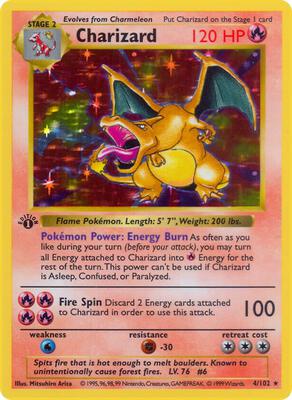
Charizard (Shadowless)
Base Set · #4/102 · Holo
~$490 raw
The card that built the hobby. Shadowless copies command a steep premium over Unlimited.
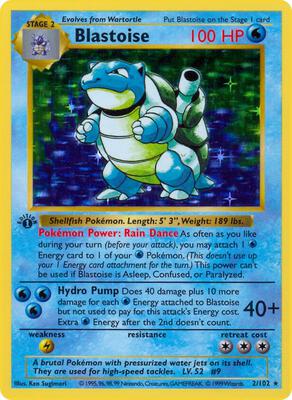
Blastoise (Shadowless)
Base Set · #2/102 · Holo
~$1,300 raw
One of the original three starters' holos — a blue-chip shadowless target.
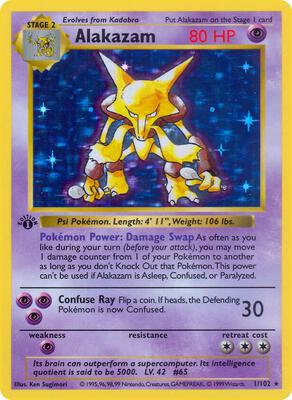
Alakazam (Shadowless)
Base Set · #1/102 · Holo
~$429 raw
Card #1 of the whole TCG, and an affordable way into shadowless holos.
Prices shown are recent raw (ungraded) market figures and move constantly — the linked ChaseDex pages carry the live number plus PSA 10/9 comps.
Worth saying plainly: the premium lives almost entirely in the holos and the higher rarities. A shadowless Common in played condition is still a cheap card — being shadowless doesn't rescue a beat-up Machop. The printing multiplies value; it doesn't create it from nothing. For the broader "rarity doesn't equal value" picture, see Understanding Pokémon Card Rarities.
Buying, grading, and avoiding fakes
Shadowless cards are 25+ years old and valuable, which is exactly the combination that attracts trouble. A few habits keep you safe:
- Confirm the printing yourself before paying a shadowless price. Sellers mislabel constantly — sometimes honestly. Run the drop-shadow and stamp checks on the actual photos, not the title of the listing.
- For anything expensive, buy it graded — or grade it. A PSA or CGC slab settles the printing, the authenticity, and the condition in one step. Raw shadowless holos in the hundreds of dollars are the sweet spot for counterfeits and "trimmed" cards.
- Watch for proxies and reprints. High-resolution fakes of Base Set Charizard are everywhere. Telltales include a too-glossy surface, wrong back coloring, and edges that look cut rather than factory-clean. When the price feels too good, it is.
- Mind the holo "swirl" and centering. Vintage holos show a cosmos/galaxy foil pattern; centering and surface scratches drive grade, and grade drives the shadowless premium harder than almost anything else.
If you're newer to vintage and want the wider playbook — storage, when to grade, how not to overpay your first month — the Pokémon Collecting for Beginners guide covers it. And to make sense of the symbols, stamps, and set marks you'll meet on older cards, keep Sets, Symbols, and Abbreviations handy.
The bottom line
Shadowless is the most overlooked few-hundred-dollars (or few-thousand-dollars) in someone's old collection. It's not a rarity icon and it's not a grade — it's a window in time, the first few weeks of the 1999 Base Set before a designer added a shadow. Learn the one test — flat artwork window, no stamp — and you can sort a pile of Base Set cards into "common" and "actually worth something" in a few seconds each. That's the whole skill, and it pays for itself the first time you catch a shadowless Charizard mislabeled as Unlimited.
Common questions
What is a shadowless Pokémon card?
A shadowless Pokémon card is an early printing of the 1999 English Base Set that lacks the drop shadow along the right and bottom edge of the artwork box. The shadow was added a few weeks into the print run to give cards more depth, so cards without it come from the earliest Unlimited print and are noticeably scarcer than the shadowed (Unlimited) version. Shadowless exists almost exclusively in Base Set.
How do I tell if my Pokémon card is shadowless?
Look at the right edge of the artwork window. If there is no grey drop shadow under the frame, the card is shadowless (or 1st Edition). Confirm with three more tells: the HP text is a thinner, lighter font; the colors are slightly washed out compared to Unlimited; and there is no 1st Edition stamp to the left of the art. If a black "Edition 1" stamp is present, it's 1st Edition, not shadowless.
Are shadowless Pokémon cards worth more than Unlimited?
Yes. Because shadowless cards came from a much smaller early print run, they trade at a premium over the common Unlimited (shadowed) version — often 2× to 5× for the same card in the same grade, and more at the top of the grading scale. They sit below 1st Edition, which is the scarcest and most valuable of the three Base Set printings.
Is shadowless the same as 1st Edition?
No. Both lack the drop shadow and share the thinner font, but 1st Edition cards carry a black "Edition 1" stamp to the left of the artwork, while shadowless cards do not. The print order is 1st Edition first (smallest run), then shadowless, then shadowed Unlimited (mass print). 1st Edition is worth more than shadowless; shadowless is worth more than Unlimited.
Which Pokémon sets have shadowless cards?
Shadowless is a quirk of the 1999 English Base Set only. Later sets (Jungle, Fossil, Base Set 2 and onward) were printed with the drop shadow from the start, so there is no shadowless variant of them. The closest cousin is the "no set symbol" error found on a small number of early Jungle and Fossil cards, but that is a separate printing error, not a shadowless variant.