Field Notes Reference 14 min read
Understanding Pokémon Card Rarities
Pokémon Company has been quietly adding rarity tiers since 2017, and we're now at the point where there are ten of them — counting Mega Hyper Rare, which is brand new as of late 2025. If you've ever pulled what felt like a chase card and weren't sure whether it was an Illustration Rare or a Special Illustration Rare or just a regular Ultra Rare with shiny treatment, this is the orientation. We'll walk the modern ladder tier by tier, look at the vintage system that came before, explain what secret rares actually are, and finish with the hardest truth in the hobby: rarity doesn't predict value the way collectors think it does.
The modern rarity ladder
What follows is the rarity stack used in Scarlet & Violet (2023+) and Mega Evolutions (2025+). Each entry below shows the icon and a representative card from a current set. Pull-rate estimates are community-sourced (PokePatch, TCGplayer Infinite, CardShopLive) — Pokémon Company doesn't publish official paper pull rates, so all numbers here have ±30% margin of error and vary by set.
Common ● — ~6 per pack
The bulk of any set. Black-dot icon, no foil treatment (regular printing), pulled in roughly 6 of every 10 cards in a pack. Functionally, these are how Pokémon ships cards that are needed in deck building but aren't worth chasing. Most Commons sell for under a quarter — but see the "Rarity ≠ Value" section below for exceptions.
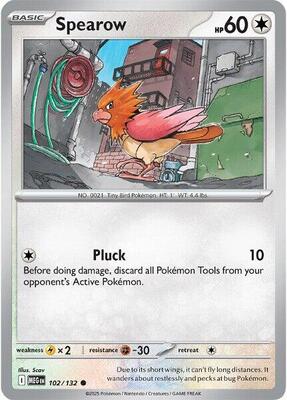
Uncommon ◆ — ~3 per pack
Black diamond icon. Slightly more dynamic Pokémon, occasional Trainer cards (Items and Supporters), and the bridge between commons and the rare-slot foils. Still no foil treatment, still cheap.
Rare ★ — typically 1 per pack (non-foil slot)
Black star icon. The "rare slot" of every pack. Modern Pokémon mostly puts a non-holo Rare here, occasionally upgrading to a Holo Rare in the same slot. Most rares sell for $0.30–$1 ungraded.
Holo Rare ★ with foil — ~70% of packs
Same black star icon, but with foil treatment across the Pokémon artwork (sometimes the whole card). Roughly 7 of every 10 modern packs upgrade their Rare slot to a Holo. These are usually the same Pokémon as the non-holo Rare, just with shiny treatment.
Double Rare ★★ — ~12% of packs
Two silver stars. Introduced with Scarlet & Violet (2023) for "rule-box" Pokémon — cards with a special game mechanic (ex, V, VSTAR). These are the basic chase cards in every modern pack: rare enough to feel like a win, common enough that most ETBs include several.
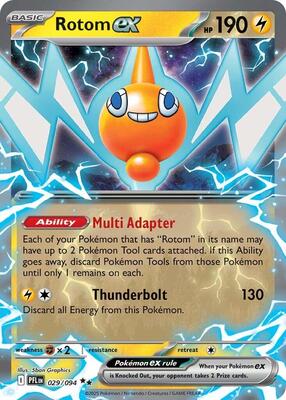
Ultra Rare ★★★ — ~5% of packs
Three silver stars. Full-art treatment on a rule-box Pokémon (ex/V/VSTAR) — same character as the Double Rare but with extended artwork that bleeds to the borders. About 1 in 20 packs pulls an Ultra Rare. Most cost $1–$10 ungraded, with chase Ultra Rares occasionally pushing into the $50+ range.
Illustration Rare — silver star, alt artwork — ~6% of packs
One silver star, but on a non-rule-box Pokémon — meaning it's a regular Pokémon (no ex/V mechanic) shown in a beautiful full-bleed scene. Often the "story" cards of a set: an Eevee in a forest, a Pikachu on a beach. These are rarer in modern era pulls than Double Rares but cheaper than Special Illustration Rares because they're not the marquee chase.
An "exception" — the Paldea Evolved Magikarp Illustration Rare became one of the most beloved alt-arts in the modern era. Despite being just one silver star, it now trades higher than most Special Illustration Rares.
Special Illustration Rare — two silver stars, alt-art chase — ~1.5% of packs
Two silver stars, full-art treatment, on a rule-box Pokémon. These are the marquee chases of every modern set. Numbered above the set total (secret rares), they typically feature the most striking artwork. The chase end of this tier is where you'll find $200–$1500+ cards in current sets.
Hyper Rare — gold-foil etched rule-box — ~0.6% of packs
The "gold cards." Three gold/silver stars (depending on era), with rainbow or gold-foil etching across the entire card. Same Pokémon as the Double Rare and Ultra Rare versions, but with a different finish. Roughly 1 in 167 packs. These are the buyer/seller "gold cards" you'll see on TCGPlayer listings.
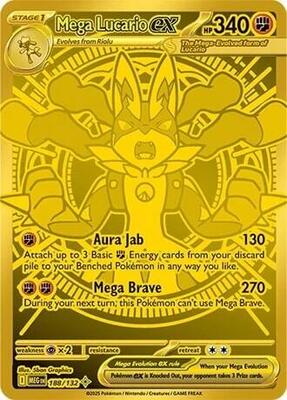
Mega Hyper Rare ♛ — ~0.5% of packs
New as of the Mega Evolutions block (ME01, September 2025). A crown-style icon, gold-foil etched, exclusively for Mega Evolution variants of Pokémon. Currently the top tier of the rarity ladder. The chase end of this tier is where the marquee Mega Evolution alt-arts live — Mega Lucario ex, Mega Charizard, Mega Gardevoir — each trading in the hundreds of dollars.
Two complicating subtypes
Beyond the standard ladder, modern sets occasionally include special-treatment variants that sit alongside the regular tiers:
Shiny Ultra Rare — a rainbow-shiny Pokémon treatment introduced for Paldean Fates and a handful of sets since. Functionally a parallel Ultra Rare tier, but with shiny-form Pokémon as the subject. Pull rates are similar to Ultra Rares.
ACE SPEC Rare — Trainer-card-only rare tier added in 2024. ACE SPEC cards are extremely powerful one-per-deck Trainers (Reboot Pod, Hero's Cape, Master Ball, etc.). Marked with a distinctive ACE SPEC banner across the top. Usually 1–2 per set; pulled roughly as often as Double Rares.
Master Ball Pattern — not technically a rarity tier, but a pattern variant that appeared with the Black Bolt and White Flare sub-sets. Common and Uncommon Pokémon get an alternate printing with a holo-pattern of tiny Master Balls overlaid on the artwork. The icon stays the same (Common = ●, Uncommon = ◆), but pull rates are much rarer than normal Commons, and prices reflect it — see below.
The vintage rarity system (1999–2017)
The original Wizards of the Coast era had three rarity tiers, period.
| Icon | Rarity | Notes |
|---|---|---|
| ● | Common | Filled black circle. About 6 of every 11 cards in a pack. |
| ◆ | Uncommon | Filled black diamond. About 3 of every 11. |
| ★ | Rare | Filled black star. One per pack, either non-holo or Holo Rare. |
There were no chase tiers above Rare in the WOTC era. The Holo Rare was the apex chase — pulled at roughly 1 in 3 packs. That was it. The closest thing to a modern "secret rare" was the Crystal-type Pokémon in Aquapolis and Skyridge (2003), which weren't numbered in the base set and had foil starburst treatment.
1st Edition and Shadowless
The vintage market also stratifies by print run, which is technically separate from rarity but functionally as important:
1st Edition cards have a small "Edition 1" stamp on the bottom-left corner of the artwork. These are the first printings of any vintage set — much smaller print runs than the Unlimited (subsequent) printings. A 1st Edition Base Set Charizard sells for 5–10× the Unlimited version.
Shadowless Base Set cards (no shadow on the right side of the Pokémon artwork) are the earliest Unlimited printings, sitting between 1st Edition and standard Unlimited in value. The shadow was added shortly after launch to make the cards "pop" more — collectors prefer the shadowless aesthetic.
Neither of these is a rarity icon. Both materially affect what a card is worth. If you're hunting vintage, this is the difference between a $50 card and a $500 card.
Secret rares explained
You'll see Pokémon cards numbered 188/132, 247/191, 294/217. The 132/191/217 is the size of the printed checklist — the cards that fill the set's main numbering. The 188/247/294 means this is the 188th/247th/294th card printed for the set, beyond the checklist. These extra cards are "secret rares."
Every set has a hidden second half above its numbered checklist. That's where the chases live.
In modern Scarlet & Violet sets, the gap between the base set count and the total printed cards is usually 40–70 secret rares. So a set with 200 cards on the checklist will print maybe 250–270 total, with the extra 50–70 being the alt-art chases: Special Illustration Rares, Hyper Rares, and (in the Mega Evolutions era) Mega Hyper Rares.
The convention dates back to 2003 — the EX era added the first "secret rares" with gold-bordered cards numbered above the checklist (looking at you, Mew ex in EX Ruby & Sapphire's 109/109 slot). It's been a Pokémon Company staple ever since.
Quick identification
If the second number in NNN/NNN is smaller than the first, you've got a secret rare. Always check both numbers; collectors and TCGPlayer listings treat secret rares as a distinct subcategory.
Rarity ≠ value
This is the section nobody tells you when you start collecting. The rarity icon on a card is a manufacturing classification — it tells you which slot the card was printed into. It does not tell you what the market will pay for it. Value is driven by four things, in roughly this order:
- Character popularity. Charizard, Pikachu, Mewtwo, Lugia, Umbreon — these always trade above their tier. A Charizard Double Rare can outsell most Ultra Rares of less-popular Pokémon.
- Illustration. A standout artwork — a wide landscape, an emotive pose, a meta moment — can push a card 10× above its tier average. The Paldea Evolved Magikarp Illustration Rare is the canonical case: a single silver-star IR that trades higher than most Special Illustration Rares because the artwork (Magikarp leaping over a waterfall, with a tiny Gyarados shadow) is universally loved.
- Print run scarcity within the tier. Master Ball pattern Commons exist as rare variants of regular Commons — same icon, much smaller print run. They trade at $25 each despite being marked as "Common."
- Cultural moment. The Prismatic Evolutions Umbreon ex SIR sat around $200 for months, then a streamer pulled one on camera and it ran to $1,500 within weeks. Demand spikes can outpace any rarity logic.
So when someone asks "is this card rare?" — they're asking the wrong question. The right question is "is this card worth something?" — and those are different.
Three cards that prove the point
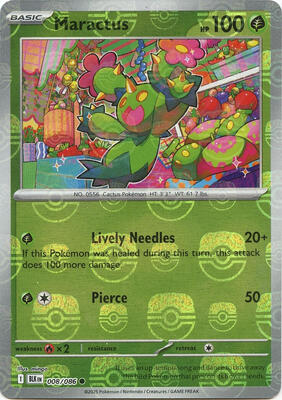
Maractus (Master Ball)
Common · ●
~$27 raw
A Common that costs more than most Ultra Rares.
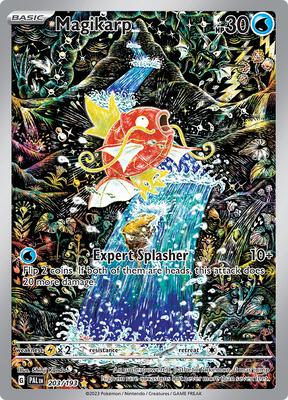
Magikarp (IR)
Illustration Rare · ★
~$378 raw
A single-silver-star IR that outsells most Special Illustration Rares.
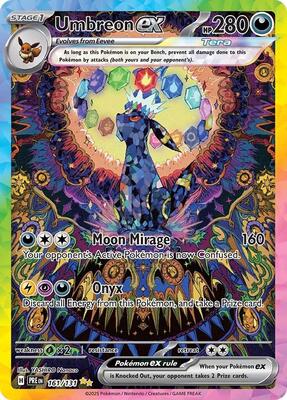
Umbreon ex (SIR)
Special Illustration Rare · ★★
~$1,466 raw
The current chart-topper. Character + alt-art + viral moment.
Pull-rate reality
If you're buying packs hoping to pull a chase card, you should know the math. Community surveys of 1000+ pack openings per set produce roughly these pull rates for modern Scarlet & Violet and Mega Evolutions sets:
| Tier | Approximate pull rate | Packs per pull |
|---|---|---|
| Common | ~55% | — |
| Uncommon | ~27% | — |
| Rare (non-holo) | ~9% of rare slot | — |
| Holo Rare | ~70% of rare slot | ~1.4 |
| Double Rare | ~12% | ~8 |
| Ultra Rare | ~5% | ~20 |
| Illustration Rare | ~6% | ~17 |
| Special Illustration Rare | ~1.5% | ~67 |
| Hyper Rare | ~0.6% | ~167 |
| Mega Hyper Rare | ~0.5% | ~200 |
These are approximate. Pokémon Company does not publish official pull rates for paper product, and rates vary set by set (Hidden Fates was famous for higher chase rates; some 151 sub-sets had aggressively low SIR odds). Treat ±30% variance as standard.
The booster math
A standard Booster Bundle is 6 packs for ~$25 MSRP — about $4.20 a pack. At those rates:
- Most packs will give you 1 Double Rare, 1 Holo Rare, and assorted Commons/Uncommons
- You'll average 1 Illustration Rare every 3 booster bundles (~$75)
- You'll average 1 Special Illustration Rare every ~11 bundles (~$275)
- You'll average 1 Hyper Rare every ~28 bundles (~$700)
This is the reason most experienced collectors recommend single-card purchasing over pack opening unless you specifically enjoy the gambling element. Buying the specific Umbreon ex SIR you want at TCGPlayer is almost always cheaper than the expected value of ripping packs to find one.
For more practical buying advice
The economics of pack opening, single-card buying, and grading decisions are covered in the upcoming Pokémon Collecting for Beginners guide.
Reading the rarity icon, in three seconds
To bring it back to identification — once you can read the modern rarity icons at a glance, you can sort any pile of cards by value tier:
- Look at the icon next to the card number, bottom-right (or bottom-left on Trainer/Energy cards — see Sets, Symbols, and Abbreviations).
- Count the stars. One = Rare, two silver = Double Rare or Special Illustration Rare, three = Ultra Rare or Hyper Rare. Crown = Mega Hyper Rare.
- Check the card number. If it's above the set total (e.g. 188/132), you've got a secret rare regardless of which tier exactly — those are the chases.
- Glance at the artwork. Full-bleed alt-art = always at least an Illustration Rare. Bordered standard art = Rare or below.
That's the entire system. The taxonomy is bloated, the icons are inconsistent across eras, and Pokémon Company will probably add another tier within two years. But the underlying logic — scarcity within a print run, sometimes correlated with value — has been the same since 1999.
Common questions
How many rarity tiers do Pokémon cards have?
Modern Pokémon TCG (Scarlet & Violet onward) has roughly 10 rarity tiers: Common, Uncommon, Rare, Holo Rare, Double Rare, Ultra Rare, Illustration Rare, Special Illustration Rare, Hyper Rare, and Mega Hyper Rare. The classic Wizards-era system had three: Common, Uncommon, Rare (plus a Holo Rare variant). The taxonomy expanded as Pokémon Company added more chase tiers to drive booster-pack engagement.
What is a secret rare in Pokémon TCG?
A secret rare is any card numbered above the printed set total. If a set has 132 cards in the base run, cards numbered 133–197 are 'secret rares' — they exist within the set but aren't part of the official numbered checklist. Secret rares are almost always the alt-art chases: Special Illustration Rares, Hyper Rares, and Mega Hyper Rares. Modern Scarlet & Violet sets typically have 40–70 secret rares each.
Can a Common Pokémon card be worth more than a Rare?
Yes — frequently. Rarity tier and market value are different things. A Master Ball pattern Common from a recent set sells for $25+, while many Ultra Rares from less-popular sets sell for under $1. Value is driven by demand, illustration quality, character popularity, and printing scarcity within the tier — not by the rarity icon itself.
What is the rarest Pokémon card?
The rarest card in absolute terms is the Pikachu Illustrator card from 1998 — only 39 PSA-graded copies exist, and a single PSA 10 sold for $5.275 million in 2022. Among regularly-released cards, the rarest tier is Hyper Rare and Mega Hyper Rare, with estimated pull rates around 1 in 167 packs. Special promotional cards (Pokémon World Championship trophies, Tropical Mega Battle prizes) are individually rarer than any rarity tier but exist outside the standard system.
What are pull rates for Pokémon cards?
Pull rates are the statistical probability of pulling a card of a given rarity from a booster pack. Pokémon Company doesn't publish them officially for paper packs, but community surveys (PokePatch, TCGplayer Infinite) of 1000+ packs per set suggest: Holo Rare ~70%, Double Rare ~12%, Ultra Rare ~5%, Illustration Rare ~6%, Special Illustration Rare ~1.5%, Hyper Rare ~0.6%. Rates vary by set.